Revenue leakage & business controls
Underbilling: The Hidden Bottleneck Between Work Completed and Revenue Collected
A business can complete the work, incur the cost and still fail to invoice everything it is entitled to bill. The problem often sits in the workflow between operations and finance.
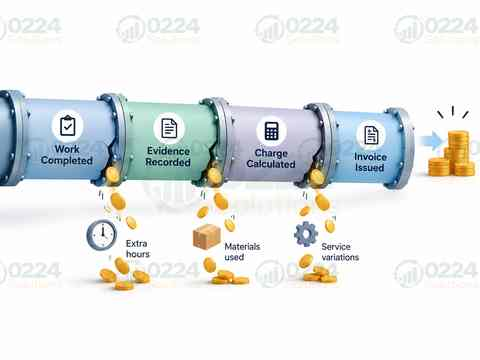
A business can be busy, profitable on paper and still lose revenue without noticing.
The problem is not always poor sales. Sometimes the work has already been won, the service has already been delivered and the cost has already been incurred. But somewhere between completing the work and raising the invoice, part of the charge disappears.
That is the bottleneck underbilling creates.
What is underbilling?
Underbilling occurs when a customer is charged less than the business is legitimately entitled to invoice for the work, goods or services provided.
That can happen because:
- completed work is omitted from an invoice;
- additional hours are not captured;
- agreed extras are forgotten;
- quantities are entered incorrectly;
- outdated prices are used;
- recurring charges fail to carry forward;
- billable expenses are missed;
- service records and invoices do not match;
- work is completed but never transferred into the billing process.
Individually, these errors can look insignificant. Operationally, repeated small omissions can create persistent revenue leakage.
The important point is that underbilling is often not primarily an accounting problem. It is a workflow problem.
The real bottleneck: information does not travel cleanly through the business
Most billing processes depend on information passing through several stages:
Customer request → work scheduled → work completed → evidence recorded → charge calculated → invoice created → invoice checked → invoice issued
Every handoff introduces an opportunity for information to be lost.
Imagine a maintenance company completes five jobs for a customer during the month. Four are part of the normal contract. The fifth requires additional materials and two extra hours of labour.
The technician records the additional work in a job sheet, but the billing team generates the invoice from the monthly contract schedule. Unless somebody compares the operational record with the invoice, the additional work may never be billed.
The business performed the work. The employee was paid. The materials were purchased. The customer received the benefit. But the revenue was never captured.
That is not primarily a sales failure. It is a control failure between operations and billing.
Why underbilling can be difficult to spot
Overbilling tends to attract attention. Customers question unexpected charges. Credit notes are raised. Complaints reach finance teams.
Underbilling behaves differently. Customers are unlikely to contact a supplier simply to point out that they have not been charged enough.
The invoice may therefore pass through the entire accounts process without triggering an obvious exception. The business sees an invoice. The customer pays it. The transaction closes. Everything appears normal.
The missing revenue may only become visible when someone compares what actually happened operationally with what was eventually billed.
The reconciliation gap
The key comparison is not simply Invoice → Payment. It is also Work completed → Invoice.
Those are two different controls. The first identifies money owed on invoices that already exist. The second can identify work that never reached an invoice at all.
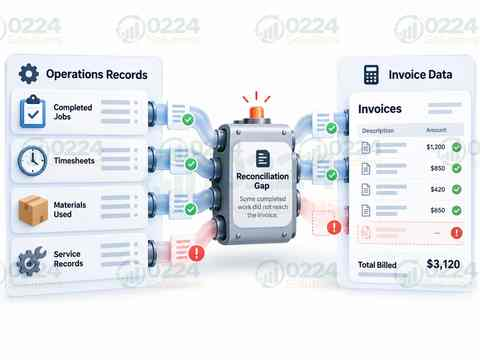
This distinction matters. A finance team can have an excellent debt-collection process and still fail to detect underbilling. If the missing charge never became an invoice line, accounts receivable has nothing to chase.
Where the bottleneck usually appears
1. Work completion is recorded in one system and billing happens in another
Operational teams may record activity in job-management systems, spreadsheets, emails, timesheets, CRM systems, project-management tools or field-service applications. Finance may invoice from a completely different source.
If those records are not reconciled, completed activity can fall between them.
2. Additional work depends on somebody remembering to report it
A process built around memory is fragile. Extra hours, additional deliveries, mileage, materials, emergency call-outs, scope changes, premium services and project variations can all be missed when someone must remember to notify finance.
3. Price changes are not reflected everywhere
A business may update its price list but continue using an old spreadsheet, outdated quote template, historic customer rates or manually entered invoice values. The invoice still gets generated, so the process appears to have worked. It has simply produced the wrong value.
4. Nobody reconciles delivery against invoices
Many businesses reconcile Invoice → Payment but never reconcile Delivery → Invoice. The first helps identify unpaid invoices. The second helps identify revenue that was never invoiced.
Manual handoffs create invisible failure points
A typical billing process may cross several people and systems:
Technician → spreadsheet → email → pricing review → finance → invoice
None of those individual steps necessarily looks dangerous. The problem arises at the handoffs. Information may be incomplete. An attachment may be missed. A variation may not be approved in time. A spreadsheet may contain an older value. An email may never be forwarded. A charge may be recorded operationally but never reach finance.
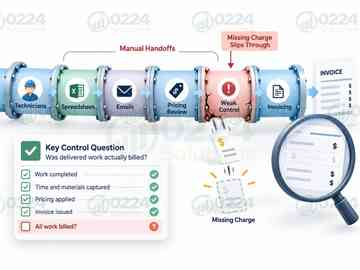
Was all delivered work actually billed?
That is stronger than simply asking whether an invoice was produced.
A simple diagnostic question
Can we prove that everything we delivered and were entitled to charge for reached an invoice?
If answering that question requires somebody to manually search several systems, inboxes and spreadsheets, there may already be a control weakness.
A stronger process creates a traceable relationship between delivery evidence → agreed commercial terms → invoice line. The objective is not necessarily to automate everything. The objective is to make omissions detectable.
The spreadsheet problem
Spreadsheets are often blamed for billing errors, but the spreadsheet itself is rarely the fundamental problem.
A spreadsheet can work effectively when ownership is clear, inputs are controlled, formulas are reliable, versions are managed, exceptions are reviewed and reconciliation takes place.
Problems emerge when multiple spreadsheets represent different versions of reality. Operations may maintain a completed-jobs spreadsheet, sales may maintain customer pricing, finance may maintain an invoicing workbook, while contract changes remain in email.
The organisation then relies on employees to manually assemble the correct answer. That creates a reconciliation bottleneck.
The cost is larger than the missing invoice value
If £500 of legitimate work is not billed, the immediate issue is £500 of lost revenue. But the business may also have already absorbed employee time, supplier costs, materials, transport, administrative processing and management overhead.
The business has therefore potentially incurred the cost of delivery without capturing all of the corresponding revenue. Repeated across many transactions, small errors can become commercially significant.
How businesses should approach the problem
The first step is not necessarily buying more software. It is understanding the billing workflow.
Map the process from the moment billable activity occurs to the moment the invoice is issued. Then identify:
- where billable activity is recorded;
- who determines what should be charged;
- where pricing comes from;
- how variations are captured;
- how invoice lines are created;
- what checks happen before invoices are issued;
- whether delivered activity is reconciled against billed activity.
At each stage ask: What could disappear here without anybody noticing?
That is where a control may be required.
What an underbilling check should compare
A useful underbilling review may compare completed jobs against invoices, timesheets against billed hours, contracted charges against invoice lines, deliveries against billed quantities, agreed rates against invoiced rates, approved variations against final invoices and recurring services against recurring charges.
The exact comparison depends on the business model. The principle remains the same: find the operational evidence of what should have been billed, then compare it with what actually was billed.
Automation can help — but only after the logic is clear
Automation becomes useful when a business performs the same reconciliation repeatedly. A system could flag completed jobs without corresponding invoice references, invoice quantities below recorded delivery quantities, billed rates that differ from approved pricing, recurring customers missing expected charges or approved extras that do not appear on an invoice.
But automating a poorly understood process simply makes the confusion move faster. The business first needs to define what constitutes a genuine exception. Technology can then make those exceptions easier to identify.
Human review still matters
Not every difference is an error. A lower invoice could be legitimate because of a customer credit, agreed discount, disputed service, bundled pricing, contractual cap, phased billing or waived charge.
For that reason, an underbilling detection process should generally identify anomalies for investigation rather than automatically classify every discrepancy as recoverable revenue.
Good operational automation supports judgement rather than pretending judgement is unnecessary.
The control businesses are really missing
Underbilling is often treated as an invoicing problem. A more useful way to understand it is as a missing operational control.
The organisation needs a mechanism capable of answering: Did everything we delivered reach the billing process at the correct quantity and rate?
Once that control exists, the business is in a much stronger position to identify leakage before it becomes routine.
Where the 0224 Underbilling Finder fits
The 0224 Underbilling Finder is designed around this reconciliation problem.
Its purpose is to help businesses examine billing data for potential mismatches and identify transactions that warrant investigation. It does not replace commercial judgement or determine automatically whether every discrepancy represents recoverable revenue.
Instead, it helps move the organisation from “We assume everything was billed correctly.” to “We can identify where the numbers do not appear to match and investigate those exceptions.”
A useful place to start
If you suspect revenue may be leaking through your billing process, start with a defined sample period. Compare what was delivered against what should have been charged against what was actually invoiced.
If those three datasets cannot be reconciled easily, the difficulty itself is useful information. It suggests that the business may need a stronger billing control.
Find the gaps before they become normal